⏰ Submission Deadline In: Loading...
ECCV 2026 Workshop · Malmö, Sweden · 8-9 September 2026

Privacy, Fairness, Accountability and Transparency in Computer Vision

Advances in computer vision continue to accelerate deployment across healthcare, robotics, surveillance, and interactive systems. PFATCV brings together researchers working on privacy-preserving vision, fairness, transparency, accountability, sensing, and responsible AI to address the technical and ethical challenges emerging from modern computer vision systems.

Overview

Advances in computer vision and sensing research have accelerated innovation at an unprecedented pace and it rapidly transforms how people work and live. Computer vision techniques have outperformed human performance in several tasks, demonstrating the potential to translate in critical real applications. Nevertheless, applying these techniques broadly in sensitive domains is met with significant hurdles, including ethical considerations, safety, and privacy issues, all of which must be thoroughly considered and resolved prior to widespread adoption.

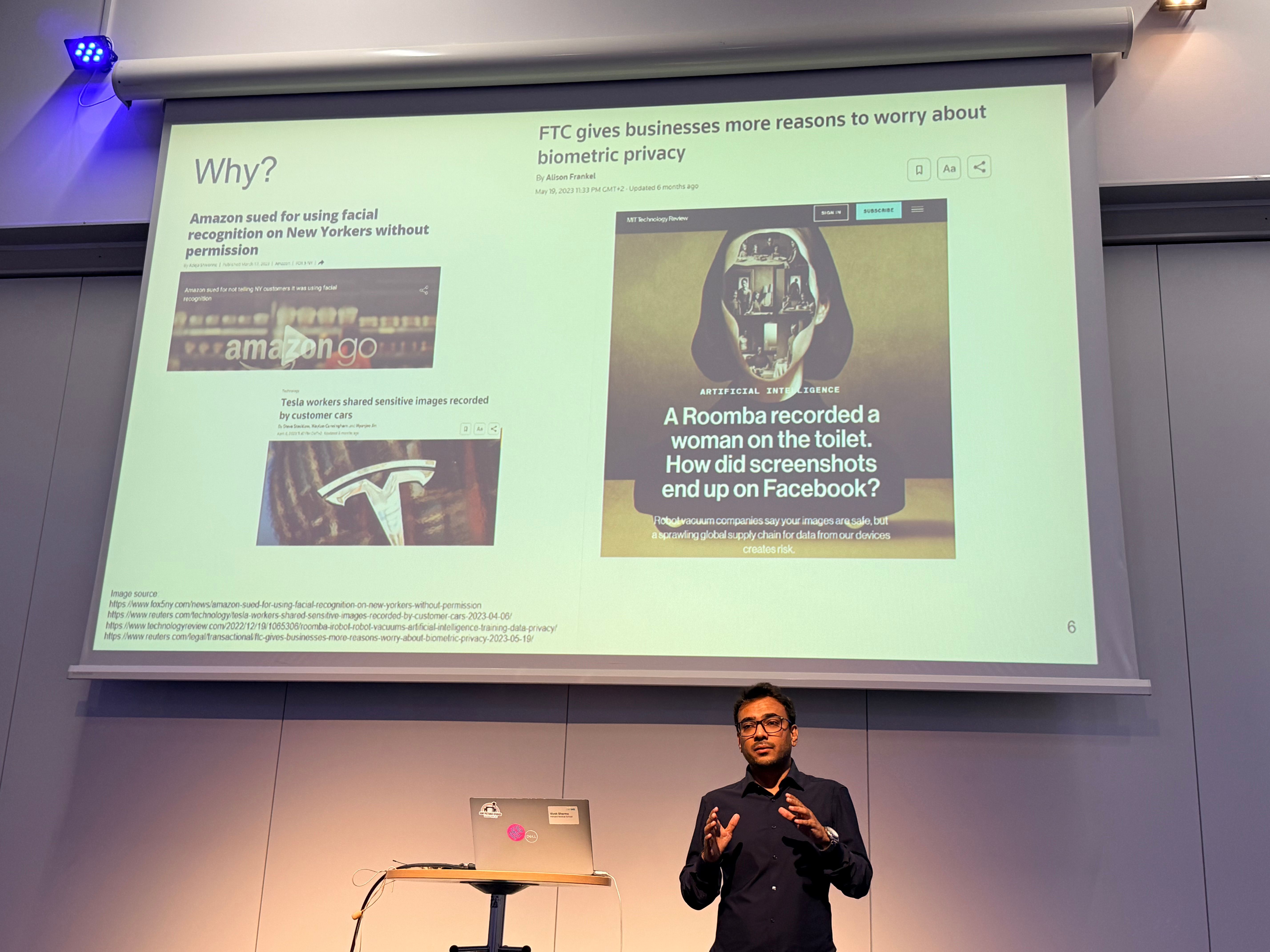
Furthermore, the ethical consideration of employing these technologies to continuous monitoring has been underestimated, since signatures of biometrics can be revealed even when subjects’ data are not directly identifiable. This workshop invites outstanding works on this technically challenging domain to highlight threats and ethical issues and propose solutions.

Progress in computer vision has outpaced the development of privacy, safety and fairness safeguards. Traditional privacy protection relies on access control, content restrictions and cryptography, yet deep learning now renders these limits insufficient to ensure the privacy or safety of models trained on sensitive data.

Meanwhile, the unprecedented concentration of spatio‑temporal user data creates profound, poorly understood risks in applications ranging from healthcare to robotics and surveillance. These risks are further amplified by generative AI and foundation models. Interpreting emerging regulatory frameworks (GDPR, AI Act) and designing methods to protect both models and data demand an interdisciplinary approach grounded in theoretical principles that can guarantee responsible deployment.

This workshop addresses a critical gap across the computer vision, sensing, cybersecurity, and ethics communities.

Topics of Interest

Include, but are not limited to:

Privacy and Security

  • Privacy-Preservation Technologies in Computer Vision (CV)
  • Privacy threats, security issues and ethical considerations in ambient and emerging sensing modalities
  • Radar, WiFi, LiDAR, neuromorphic, and event-based vision
  • Privacy-preserved Learnable Optics and hardware in CV

Responsible and Trustworthy AI

  • Attribution and authenticity in computer vision
  • Public datasets for PFATCV
  • Privacy-preservation and Fairness in synthetic data generation
  • Metrics and Benchmarks for analysing privacy and ethical risks in CV

Healthcare and Federated Learning

  • Computer Vision in Privacy-Sensitive Domains
  • Privacy-Enhancing Human Biometrics
  • Privacy, Fairness, Accountability and Transparency in Medical Imaging
  • Privacy, Fairness, Accountability and Transparency in Federated Learning for Computer Vision applications
  • Differential privacy and theoretical guarantees for privacy-preserving CV

Important Dates

All deadlines are in AoE unless stated otherwise.

  • Paper submission10 July 2026
  • Notification of Acceptance1 August 2026
  • Camera ready7 August 2026
  • Workshop date8-9 September 2026

Invited Speakers

Researchers and industry leaders working across responsible AI, privacy-preserving computer vision, sensing, and authenticity.

Organizing Committee

Organizers from academia and industry spanning computer vision, sensing, healthcare AI, robotics, privacy-preserving machine learning, and authenticity.

Prof. Margarita Chli

Prof. Margarita Chli

University of Cyprus / ETH Zurich

Website ↗
Prof. John Collomosse

Prof. John Collomosse

University of Surrey / Adobe Research

Website ↗

Technical Committee

  • Kaushik Bhargav Sivangi — University of Glasgow
  • Muhammad Ilham Rizqyawan — University of Glasgow
  • S. Mohammad Sheikholeslami — University of Toronto
  • Jinpei Han — Imperial College London
  • Wei Tang — City University of Hong Kong
  • Pati Palo — University of Oxford
  • Mattia Carletti — University of Oxford
  • Fredrik Gustafsson — University of Oxford

Reviewer Invitation

We welcome qualified reviewers and researchers working in privacy-preserving computer vision, trustworthy AI, sensing, security, fairness, transparency, and responsible machine learning to join our reviewer pool for PFATCV @ ECCV 2026.

Call for Papers

We invite submissions on privacy-preserving computer vision, fairness-aware learning, transparency and accountability in AI, privacy-sensitive sensing modalities, authenticity and provenance, medical imaging, federated learning, and responsible deployment of computer vision systems.

Submission Details

Full paper submissions
Up to 14 pages, excluding references. Accepted papers will be included in the proceedings.
Poster paper submissions
2–6 pages, excluding references. Accepted papers will NOT be included in proceedings.

Contact

For questions, contact fani.deligianni@glasgow.ac.uk. Primary contact for workshop inquiries and submissions.

Previous Editions